Bathroom Vanity Guide: Sizes, Materials, Adelaide Showrooms
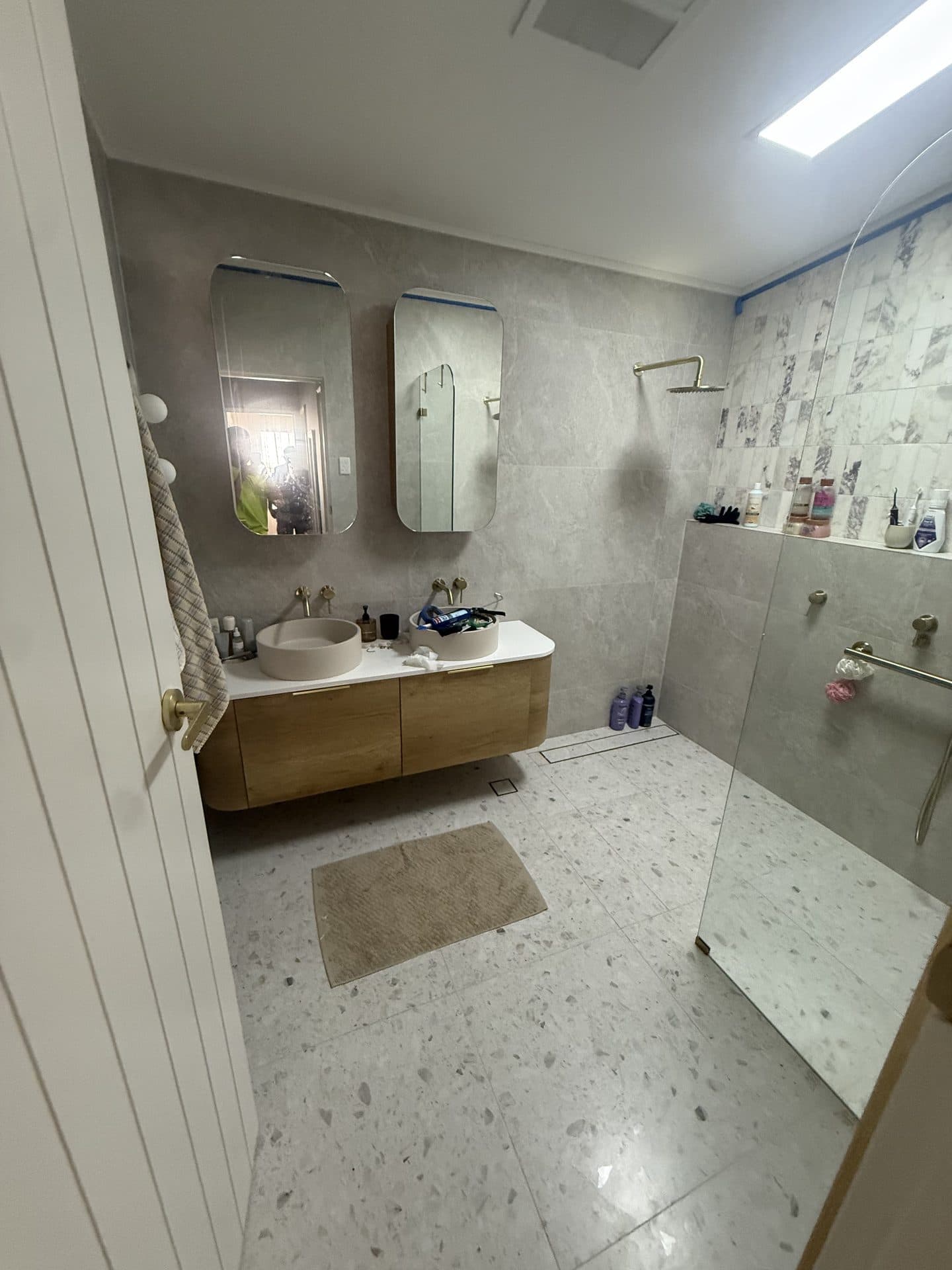
The vanity is the single most-used fitting in any bathroom. You stand at it every morning and every night. Getting it right changes how the room feels in daily use more than almost any other decision.
This guide covers the three questions you need to answer before signing off on a vanity: size, style (wall-hung or freestanding), and materials. Plus the practical detail about vanity heights that most Adelaide renovators do not discuss until it is too late.
Size: the first decision
600mm
Smallest standard size. Suits powder rooms and ensuites where a full-size vanity will not fit. Single basin, minimal bench space. Typical cost $600 to $1,400 (supply).
750mm
Smallest comfortable main bathroom size. Single basin with about 300mm of bench to each side. Typical cost $800 to $1,800.
900mm
The most common main bathroom size in Adelaide. Single basin with generous bench, or offset basin with a longer bench. Fits most rooms comfortably. Typical cost $1,400 to $2,800.
1200mm
The sweet spot for larger bathrooms and many ensuites. Single large basin or dual basin configuration. Typical cost $1,800 to $4,200.
1500mm and above
Dual basin vanities for shared ensuites and larger main bathrooms. Often custom-made. Typical cost $2,500 to $6,500.
Wall-hung or freestanding?
Wall-hung
Wall-hung (floating) vanities show the floor underneath, which visually enlarges the bathroom. This is the dominant style in modern Adelaide bathrooms.
Installation requires wall blocking: a timber or steel plate inside the wall at the mounting point, sized to take the weight of the vanity plus typical daily use. If the wall does not have blocking, your installer adds it. For a new bathroom this is standard; for a vanity swap into an older wall it adds $150 to $300 in labour.
Freestanding
Freestanding vanities sit on legs or a plinth. Easier to install, cheaper to replace, and they hide plumbing behind the kickboard. They also handle uneven floors better than wall-hung.
For small bathrooms (under 5 square metres), wall-hung wins on visual space. For larger bathrooms, either works: the choice becomes purely aesthetic.
Materials that last vs materials that fail
Cabinet carcass
Solid timber is rare and expensive. Usually only on high-end or custom vanities. Beautiful but requires maintenance in humid bathrooms.
Birch ply is the premium engineered option. Stable, resistant to moisture, and takes paint or veneer beautifully. Used on designer vanities from Issy, ADP, and Loughlin Furniture.
MDF dominates the mid-range and budget market. Medium Density Fibreboard is stable if sealed properly but swells if water gets past the edge seal. Kickboards and back panels are the weak points. Stay with quality brands (Kado, Fienza, Omvivo) that use moisture-resistant MDF (green-core) for bathroom use.
Particleboard is the cheap option. Will swell within 5 years in any bathroom. Avoid.
Benchtop
Stone (Caesarstone, Silestone, Smartstone) is the 2026 default. Non-porous, stain-resistant, available in most colours and finishes. Adelaide pricing: $750 to $1,800 for a standard vanity top.
Natural stone (marble, granite) is premium. Marble is beautiful but can etch from acidic products; granite is more forgiving. Adelaide pricing: $1,200 to $3,500.
Laminate is the budget option. Good laminate lasts 15 years in normal bathroom use. Cheap laminate fails at the edges within 5 years. Adelaide pricing: $250 to $650.
Timber or solid surface (Corian, Staron) is a niche choice. Timber requires oiling, solid surface is durable but uses a plastic-looking appearance that is falling out of fashion.
Basin
Ceramic is the standard. Glazed vitreous china, chip-resistant, easy to clean. Almost every Adelaide vanity comes with a ceramic basin as default.
Stone (moulded or solid) is premium. Freestanding basins carved from a single piece of stone or moulded from engineered stone. Typically $800 to $3,500.
Concrete has a distinct industrial or organic look. Reliable if sealed, but porous if not. Typically $600 to $1,800.
Vanity height: the decision most Adelaide renovators miss
Standard Australian vanity height is 880mm to 900mm (top of benchtop to floor). This suits a user around 170cm tall. For taller users, standing at a 880mm vanity is stooped and uncomfortable. For shorter or mobility-limited users, standing at a 900mm vanity requires reaching.
Our recommendation:
- Users 160cm or under: 800mm to 830mm
- Users 160 to 175cm: 880mm to 900mm (standard)
- Users 175 to 185cm: 900mm to 920mm
- Users 185cm+: 920mm to 950mm
- Wheelchair or mobility-device users: 780mm to 820mm with knee clearance
Most renovators default to 900mm without asking. Ask specifically for a height decision. The difference is measurable in daily use and free to specify.
Adelaide vanity showrooms worth visiting
Before buying, visit two or three showrooms. Bring a tape measure. Check drawer mechanisms by opening and closing them repeatedly. Inspect the kickboard for moisture-resistant treatment.
Top Adelaide showrooms include Reece, Highgrove Bathrooms, Harvey Norman, Beaumont Tiles (has vanity ranges), and Bunnings (for budget tier). Designer showrooms like English Tapware Company and The Waterworks supply premium and imported vanities.
Matching tapware to the vanity
Tapware has to be chosen before the vanity is finalised because the basin needs to accommodate the tap style.
- Mixer tap on the bench: the most common. Works with any basin. Bench needs a pre-drilled tap hole.
- Wall-mounted spout: modern and clean. No tap hole needed in the bench. Plumbing goes into the wall behind. More expensive to install.
- Pillar taps (separate hot and cold): heritage and traditional styles. Two tap holes needed.
Tapware finish should coordinate (but not necessarily match exactly) with other bathroom fittings: shower mixer, towel rail, and toilet accessories. Matte black, brushed nickel, and chrome are the dominant 2026 Adelaide finishes.
Install it yourself or get the pro in?
In South Australia, plumbing work on a vanity requires a licensed plumber. This means the water supply connection, the waste trap, and any pipework modification must be done by someone with a current licence.
You can legally install the vanity carcass yourself if the wall is ready, the plumbing is already in place and aligned, and you are only doing the carpentry side. For most Adelaide homeowners, the cost of a professional install ($450 to $1,200 depending on complexity) is worth it for the warranty and the plumbing certification.
Get a fixed-price quote that includes the vanity
Tell us your preferred size, style and budget, and we’ll pass your enquiry to a local Adelaide bathroom renovator who can quote vanity supply and install.